

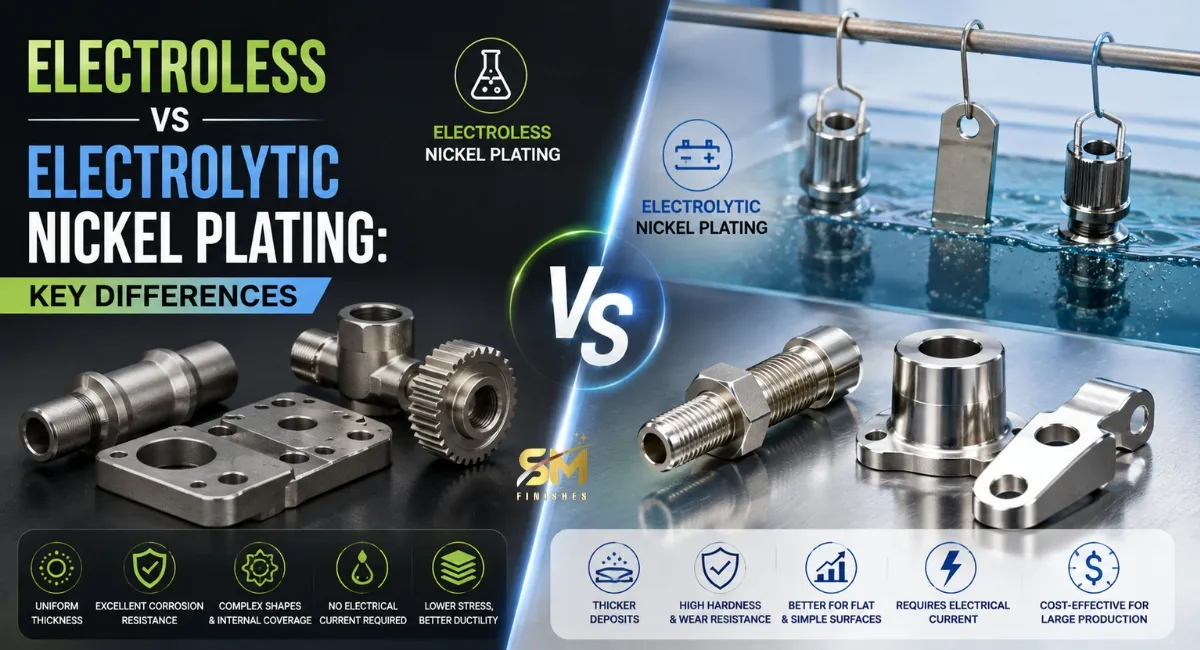
Electroless vs Electrolytic Nickel Plating: Key Differences
Electrolytic nickel uses current and plates fastest on edges. Electroless nickel uses a chemical reduction and follows the surface — including holes and recesses.
Electrolytic nickel is the workhorse undercoat and bright finish on open connector contacts. Thickness builds where current density is high. When specified, SM Finishes plates to ASTM B689 / QQ-N-290. See nickel plating.
Electroless nickel (EN) deposits without external current, so throw into complex hybrid-connector hardware is more uniform. Phosphorus content and heat treatment belong on the drawing. When specified, we process to ASTM B733 / MIL-C-26074. See electroless nickel.
Key differences that belong on the RFQ
- EN for uniform build on shells, fittings and recessed geometry.
- Electrolytic nickel as a barrier under gold or as a bright contact finish.
- EN phosphorus class and heat-treat are drawing callouts — not a default “chemical nickel”.
- Both can be RoHS-suitable engineering deposits when processed without restricted substances — confirm the drawing. In-house XRF includes RoHS / WEEE / ELV heads.
Mixed BOMs are common: electrolytic nickel under gold on contacts, EN on a complex shell. Quote both so fixturing is planned once. Process control is ISO 9001:2015 and AS9100:2015 from Machohalli, Bengaluru, for India, Japan and Taiwan programmes. Lead time depends on heat-treat and geometry, quoted after the RFQ.