

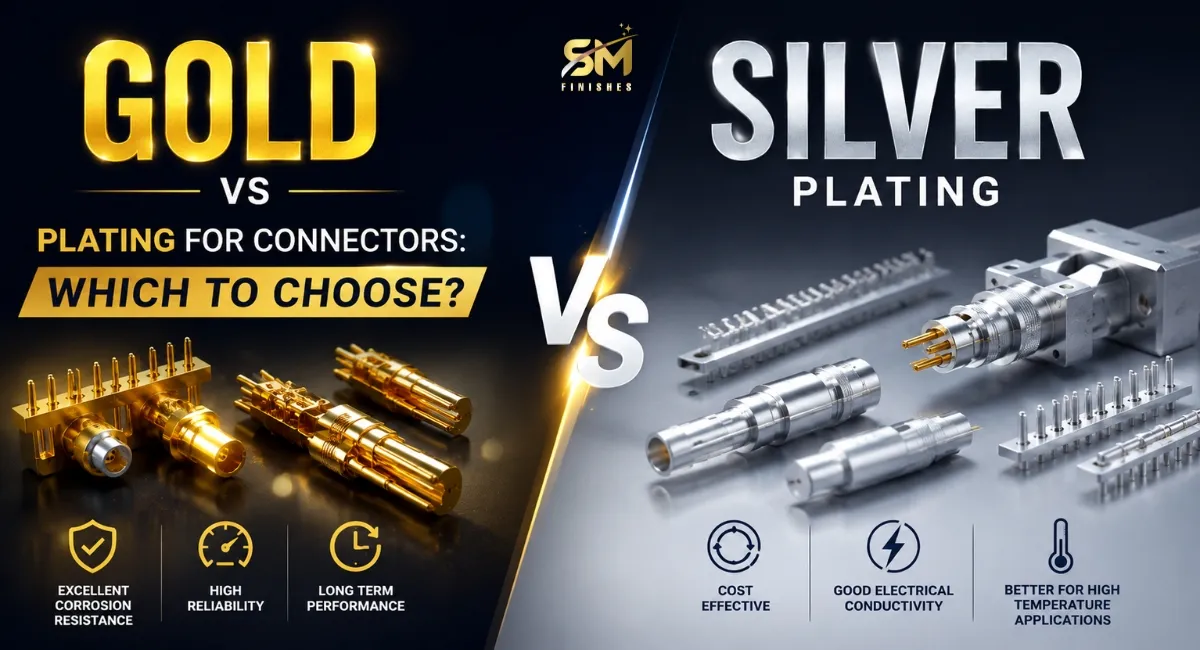
Gold vs Silver Plating for Connectors: Which to Choose?
Gold vs silver plating for connectors is a specification choice, not a finish preference. The wrong metal shows up as tarnish, wear, or cost — not as a logo on a datasheet.
Choose gold plating on hybrid connector signal contacts when mating cycles, corrosion immunity and stable low contact resistance matter (aerospace, defence, high-speed data). Gold does not form a sulphide film the way silver does. SM Finishes plates gold to ASTM B488 / MIL G 45204 callouts when they appear on the drawing, 0.05 µm to 10 µm, under ISO 9001:2015 and AS9100:2015 in Machohalli, Bengaluru.
Choose silver plating when current density dominates — power terminals, high-current automotive, EV and industrial contacts — and the design can accept tarnish control or a sealed environment. Silver is usually the lower-cost metal for thick, high-conductivity layers. When specified, we plate silver to ASTM B700 / MIL QQ S365.
When gold is the right connector finish
Gold over a nickel barrier is the default for low-energy hybrid contacts that must stay stable after humidity, mixed-gas or long storage. Pores in a thin flash let base metal corrode; that is why undercoat control and XRF thickness on the functional face belong on the traveller, not only in a brochure. Japanese and Taiwanese aerospace and electronics prints often name gold purity and nickel barrier together — send both with the RFQ.
When silver is the right connector finish
Silver carries more current for a given section than gold at lower metal cost. EV and rail power pins, bus-style terminals and some industrial hybrids specify silver for that reason. Anti-tarnish after plate matters for humid export packing. If the same housing also has gold signal pins, the two baths must be sequenced so they do not contaminate each other — that is a process-planning item, not a colour choice.
A practical RFQ split
- Gold over nickel on low-energy / high-reliability hybrid contacts.
- Silver on high-current terminals where the spec allows it.
- Tin when the joint will be soldered and gold is not required — see bright tin.
SM Finishes plates both from Bengaluru for India, Japan, Taiwan and South Asia programmes, including PPAP where the automotive print requires it. Send contact force, current, environment and mating-cycle numbers with the drawing. Lead time is quoted per lot — we do not publish a catalogue day-count.