

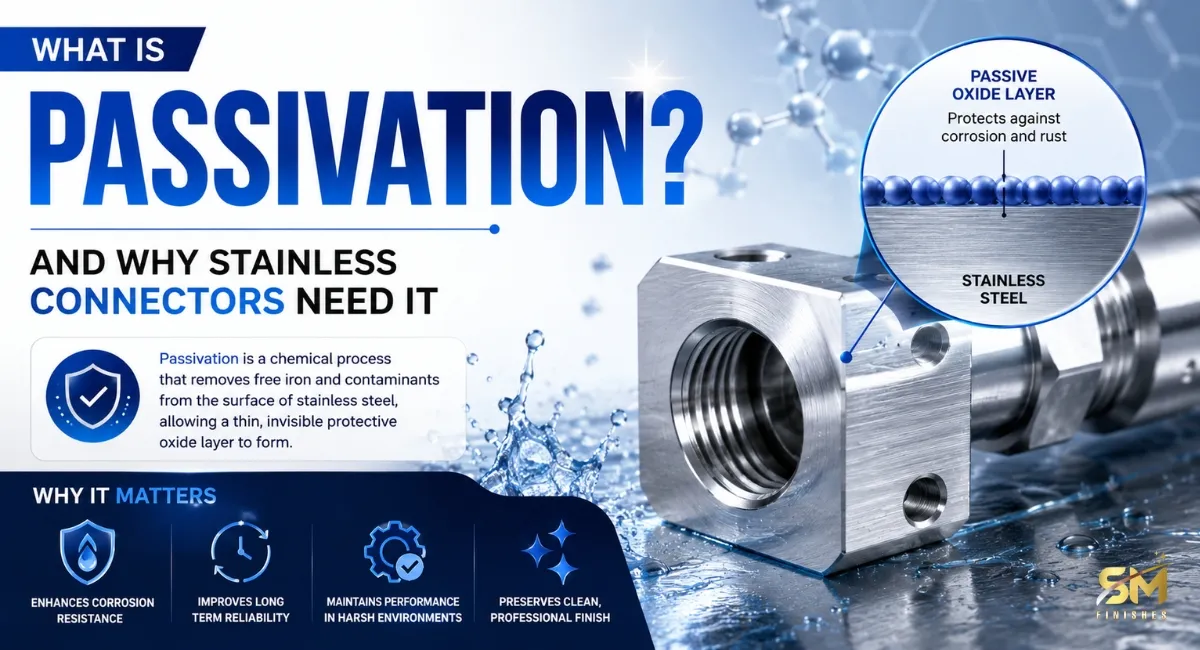
What Is Passivation and Why Stainless Connectors Need It
Passivation is a chemical process that restores the chromium-rich oxide film on stainless steel after machining or welding. It is not a plated layer and it does not add gold-style micrometres of metal.
Stainless hybrid-connector shells, clamps, fasteners and brackets are machined, tumbled or welded. Those operations smear iron and break the passive film. Left untreated, the part rusts in humidity even though the alloy is “stainless”. Stainless passivation at SM Finishes restores that film to drawing — including ASTM A967 type processes where specified — under ISO 9001:2015 and AS9100:2015 in Machohalli, Bengaluru.
What passivation is — and is not
Passivation is for stainless. Aluminium housings need chemical conversion coating (MIL C 5541-type classes on the print), not passivation. Gold, silver and tin on contacts are electroplated deposits. Mixing those words on an RFQ is how lots get quoted against the wrong tank.
Japanese and Taiwanese prints often name ASTM or AMS passivation types and hexavalent vs trivalent chemistry constraints. Send that with the first RFQ so we confirm tank capability before samples. We will not substitute plating for passivation, or passivation for conversion on aluminium.
Why stainless connectors need it
Connector hardware lives in salt, condensation and handling. A broken passive film on a stainless shell becomes a corrosion site next to gold-plated contacts. Aerospace and defence travellers want the passivation type auditable; automotive electronics often want the same discipline when the housing is stainless.
Mixed-metal assemblies are normal: passivated stainless, conversion-coated aluminium, gold or tin contacts. Sequence so one chemistry does not attack the other alloy. Quote the full BOM finish list — see also certifications and process specs on About.
Founded October 2019; William Anthony Raj J, 27 years in surface engineering. Lead time is quoted from alloy, spec type and whether the same assembly also needs plating.